UN Secretary-General Meets Pakistan Global Alumni Network in Islamabad
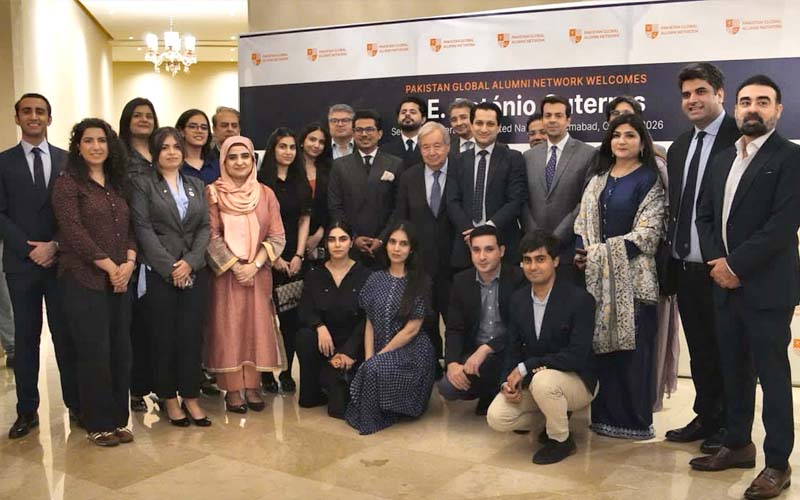
ISLAMABAD: United Nations Secretary General António Guterres sat down with members of Pakistan’s internationally educated community this week, taking part in a high level roundtable organised by the Pakistan Global Alumni Network (PGAN) in the federal capital. The session opened a frank discussion on where Pakistan stands in a world undergoing rapid political, environmental and technological change.
The meeting took place during the UN chief’s official three day visit to Pakistan from October 6 to 8. A delegation of 20 PGAN members attended, representing a wider body of more than 6,000 alumni of Pakistani origin who have studied at universities across the globe.
Conversation at the table ranged across several pressing issues, including the direction of the United Nations itself, shifting global power dynamics, climate pressures, population growth, artificial intelligence and the way work is being redefined.
Guterres spoke about Pakistan’s long record of service to the United Nations. He pointed to the country’s contribution to peacekeeping missions, its decades of sheltering millions of Afghan refugees, and its continuing struggle against climate impacts it did little to create.
He also described Pakistan’s large youth population as among its most valuable resources, recalling the talent and energy he has observed on his repeated trips to the country.
The Secretary General’s connection with Pakistan goes back many years. He first built close ties during his term as UN High Commissioner for Refugees, and returned in his current role after the devastating floods of 2022, one of the worst climate linked disasters the country has faced.
Delegates used the platform to question him directly. One line of discussion focused on how his successor might keep the United Nations credible and effective as competition between the United States and China intensifies, without the body turning into a stage for rivalry between major powers.
Participants also pointed to the growing distance between the organisation’s legal and moral standing and its practical influence over conflicts such as those in Gaza, Iran and Ukraine. They asked how trust in multilateral institutions could be rebuilt at a time of rising public doubt, and how the value of collective action could be shown more convincingly.
Climate and demographic strain featured heavily. Attendees observed that Pakistan accounts for under one per cent of global emissions while sitting among the most climate vulnerable nations. The country is also adding close to five million people every year, which places urgent demands on employment, skills training, infrastructure and social development.
Artificial intelligence drew particular attention in relation to Pakistan’s young workforce. With automation reshaping industries and job markets, delegates asked for the Secretary General’s view on how developing economies can share in technological gains rather than fall further behind.
The group further examined whether the UN system could move away from scattered, sector by sector programmes towards a more unified financing and support structure, allowing governments to prepare for climate, population and technology related shocks before they escalate into emergencies.
The roundtable formed part of a broader programme during the visit. Guterres also toured the National Emergencies Operations Centre at the National Disaster Management Authority, where officials briefed him on Pakistan’s move towards technology driven disaster preparedness using artificial intelligence, machine learning, Internet of Things systems and advanced data tools for early warning.
Elsewhere during the trip, he commended Pakistan’s diplomatic efforts, particularly its part in helping open space for talks between Washington and Tehran. He referred to the country as a source of solidarity and solutions, adding that its standing and credibility lend it a valuable voice in international affairs.
The Islamabad discussion closed on an optimistic note, presenting Pakistan as a nation facing serious climate, demographic and technological tests, yet equipped with a young population, a wide international talent base, a strong peacekeeping record and a steadily expanding diplomatic footprint.
For PGAN, placing that global Pakistani expertise in direct dialogue with the head of the United Nations served as a clear illustration of what an internationally connected knowledge community can contribute to the country’s future.